Why does David switch from “He” to “You” in Psalm 23?what it means, verse by verse
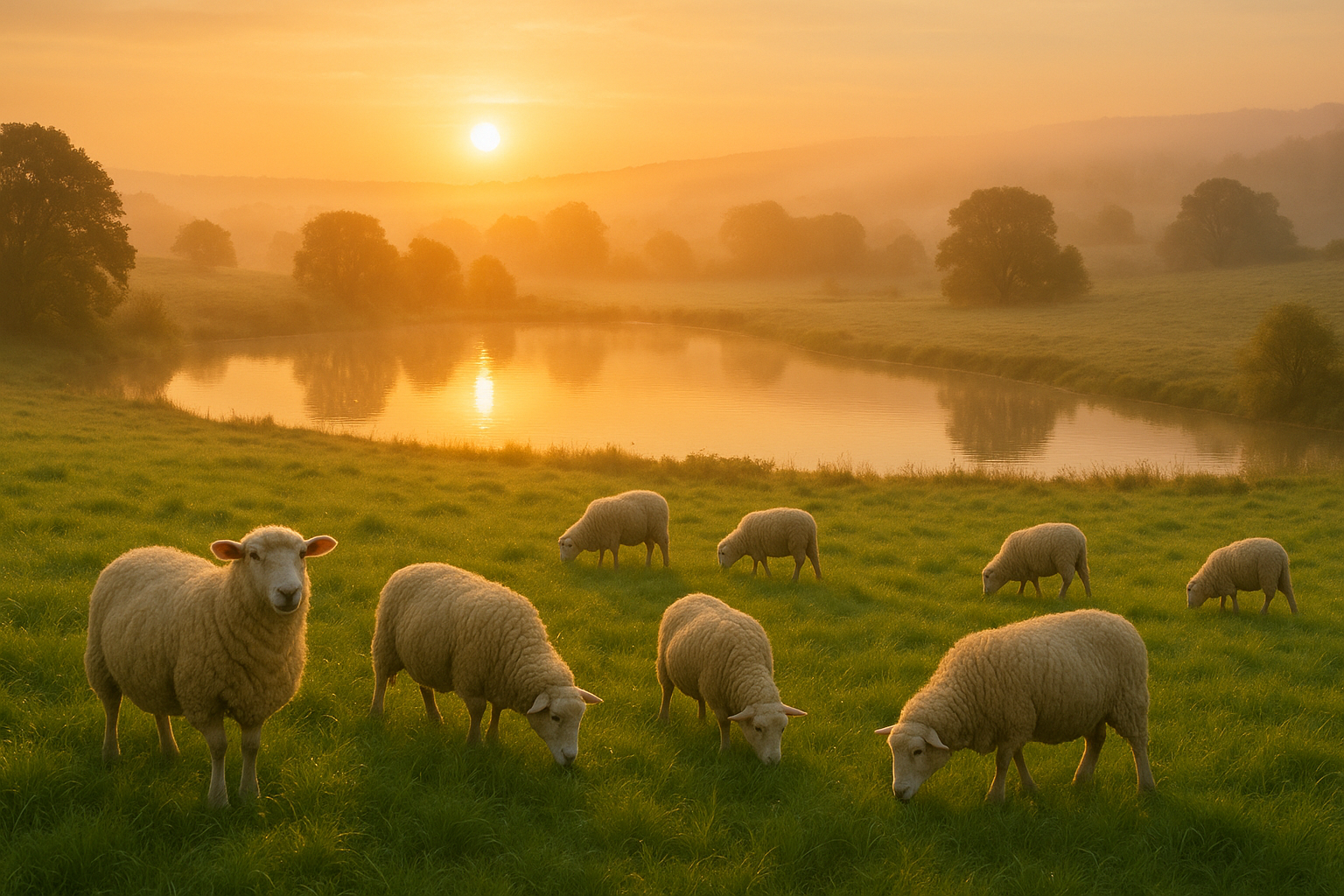
On the coverThe sheep grazing in green pasture are verse 2: "he makes me lie down in green pastures." The still waters in the background come from the same verse: sheep won't drink from a rushing stream. The dawn light is a day beginning under care. And the shepherd out of frame: in the psalm, you can tell he's there by the state of the sheep.
If there's one passage of the Bible that has crossed every border — recited in hospitals, whispered at farewells, embroidered in frames on grandmothers' walls — it's Psalm 23. Six short verses, brief enough to memorize, deep enough that a whole lifetime can't exhaust them. But precisely because we know the words so well, we sometimes never stop to hear what they're saying. So let's do what this blog loves to do: open it slowly, verse by verse, in plain language — and bring it into real life.
First, one detail that changes the entire reading: the author is David — who spent his youth as a shepherd in the fields of Bethlehem. He isn't borrowing a poetic image he heard somewhere; he's describing his own job. David knew exactly what a shepherd does for his sheep — and one day it dawned on him: that's what God does for me.
Verse 1 — The word that changes everything: "my"
"The Lord is my shepherd; I shall not want." Psalm 23:1
The power of the most famous verse in the Bible fits in one small word: "my." David doesn't say "the Lord is a shepherd" or "the shepherd of the people" — he says my. It's a personal relationship, the voice of someone who has let himself be shepherded. And "I shall not want" isn't a promise of wealth: it's the confidence of a sheep who knows that the One caring for her won't let the necessary run out. The question this verse asks is simple and enormous: is He the shepherd... or is He yours?
Verse 2 — The rest He provides
"He makes me lie down in green pastures; He leads me beside still waters." Psalm 23:2
Here's a shepherd's secret David knew well: sheep don't lie down just anywhere. A sheep only lies down when she's fed, unafraid and at peace — any tension, and she stays on her feet, alert. So when David says the shepherd "makes me lie down," he's saying: near Him, the conditions exist for a rest I can't manufacture on my own. In a world that treats exhaustion like a trophy, the God of the Bible insists on your rest. He doesn't lead you to the rapids — He leads you to still water.
Verse 3 — The soul restored
"He restores my soul; He leads me in the paths of righteousness for His name's sake." Psalm 23:3
"Restore" is a word for something that has worn out. David is admitting what everyone feels and few say out loud: the soul gets tired. Not just the body — that inner depletion vacations don't fix. And the promise is that God doesn't discard the worn-out soul: He restores it. Notice, too, the reason behind the "paths of righteousness": for His name's sake. God leads you down the right path not because you earned it — but because caring well for the sheep is the Shepherd's honor.
Verse 4 — The valley (and the shift from "He" to "You")
"Even though I walk through the valley of the shadow of death, I will fear no evil, for You are with me; Your rod and Your staff, they comfort me." Psalm 23:4
First, the honesty of the verse: it says "even though I walk through the valley" — not "in the unlikely event a valley exists." Psalm 23 doesn't promise a life without valleys; it promises company inside them. But notice the most beautiful detail in the whole psalm, hidden in the grammar: up to this point, David spoke of God as "He" — "He makes me lie down," "He restores." In the valley, it changes: "YOU are with me." When life presses in, God stops being a topic and becomes a presence. The conversation about Him turns into a conversation with Him. Anyone who has walked through a real valley knows exactly what David meant.
Verse 5 — A table set before enemies
"You prepare a table before me in the presence of my enemies; You anoint my head with oil; my cup runs over." Psalm 23:5
The scene shifts from the field to a house — and the Shepherd becomes a host. And what a detail: the table is set "in the presence of my enemies." God doesn't wait for the trouble to leave before giving you peace; He serves the banquet with the trouble still watching. Oil on the head was the gesture of honor reserved for special guests; the overflowing cup is generosity without measure. In plain terms: in the middle of the battle, you are not tolerated at God's table — you are the guest of honor.
Verse 6 — The goodness that runs after you
"Surely goodness and mercy shall follow me all the days of my life, and I will dwell in the house of the Lord forever." Psalm 23:6
The psalm opens with God out front, leading — and closes with His goodness behind, following. In front and behind: the sheep walks surrounded. And the verb David chose is strong: in the original language, "follow" carries the tone of pursue — God's goodness doesn't trail you from a distance; it runs after you. The final destination isn't a place, either: it's staying close to the One who cares, "forever." That's what David wanted from verse 1 on — not the pastures, not the table: the Shepherd.
What Psalm 23 promises — and what it doesn't
It doesn't promise a life without valleys, without enemies, without ever lacking anything material. The psalm itself mentions the valley, the shadow, death and enemies — they're part of the sheep's route.
It promises something greater: a Shepherd who doesn't abandon. Rest provided, a soul restored, company in the valley, honor at the table, and goodness in pursuit. The psalm isn't a map without dangers — it's the certainty of never crossing them alone.
One small practice to carry from the reading: today, at some point, swap the "He" for "You" — instead of thinking about God, talk with Him, the way David did in the valley. It can be a single sentence: "You are with me." That's the heart of the whole psalm.
Questions people bring here
Who wrote Psalm 23?
David, the shepherd boy who became king of Israel. That's why the imagery is so precise: he describes God's care using the work he did his whole young life — protecting, feeding and guiding sheep through the fields and valleys of Bethlehem.
Can I pray Psalm 23 every day?
Yes — and it's a beautiful habit. Just remember the power isn't in repeating the words, but in the trust they express. Prayed from the heart, the psalm becomes shelter; repeated as a formula, it's just sound.
What does "the valley of the shadow of death" mean?
The valleys in David's region were narrow, dark ravines with real danger from predators — the most perilous stretch of the sheep's route. In life, it's any dark crossing: illness, grief, fear, crisis. The verse doesn't deny the valley; it affirms the company inside it.
To carry in your pocket today
In the valley, God stops being "He" and becomes "You." It's not a psalm about having no fear — it's about never being alone.
A small prayer
Lord, be my shepherd — not a distant shepherd, but mine. In today's valley, remind me that You are with me. Amen.